Maine Senate Primary Tests Whether Democrats Will Keep Deferring to Their Leaders
A Commentary By J. Miles Coleman and Kyle Kondik
KEY POINTS FROM THIS ARTICLE
— Gov. Janet Mills’s (D-ME) Senate run sets up an intriguing primary that will test Democratic voters’ willingness to go along with the preferences of party leaders.
— Mills’s most prominent rival, oyster farmer Graham Platner (D), is already attacking her, and the primary illustrates several fissures in the party, including insider vs. outsider and older vs. younger.
— There are several instances of sitting governors losing Senate primaries in the postwar era, but these are generally from decades ago.
The Maine Senate primary
We wrote a couple of weeks ago about how the shutdown fight—yes it is still going on, even though it most definitely is not dominating the news—perhaps represented a turning point moment for Democrats, akin to the internal strife on the Republican side in the years leading up to Donald Trump becoming the leader of the party. Part of that internal strife manifested itself in primaries in which candidates best described as outsiders sometimes defeated more establishment-oriented candidates in Republican primaries. Democrats have certainly not been completely immune to outsiders beating insiders in primaries—this is how Rep. Alexandria Ocasio-Cortez (D, NY-14) started her career in Congress, after all—but in our years of following primaries, national Democrats have much more often than not gotten their preferred candidates through primaries, or helped their preferred candidates avoid primaries altogether.
Former Gov. Roy Cooper’s (D) entrance into the North Carolina Senate race earlier this year was a good example. Following his announcement, Cooper quickly consolidated Democratic support, and the leading candidate before his entrance—former Rep. Wiley Nickel (D, NC-13)—immediately left the race, later announcing a run for Wake County (Raleigh) district attorney.
There are examples of national Democrats not getting their preferred candidate through a primary. One example, cited by Democratic operative John Lapp in a Center for Politics panel last week, came in Montana, when then-state Sen. Jon Tester defeated then-state Auditor John Morrison in 2006. Tester went on to win the seat that year, holding it for three terms before losing last year. A few years later, in 2010, Sen. Arlen Specter of Pennsylvania switched parties, but he lost in the Democratic primary to then-Rep. Joe Sestak (D, PA-7). Sestak then lost a close general election. Six years later, in 2016, the Democratic Senatorial Campaign Committee spent on behalf of former state environmental official Katie McGinty against Sestak in the primary. McGinty won the primary but lost a close general election, calling into question the logic of spending in the primary.
With Gov. Janet Mills (D-ME) entering the Maine Senate race on Tuesday—and at least two of her primary rivals at least initially declining to defer to her—we may be getting a key primary test of the “establishment” vs. “outsider” dynamic on the Democratic side. This would be taking place in the context of a vitally important Senate race for Democrats. As we noted in our analysis of the race in our previous issue, when we moved the general election from Leans Republican to Toss-up, this is the only Senate seat in a Kamala Harris-won state that Republicans hold. Given Democrats’ structural disadvantages in the Senate—fully half of the entire membership of the Senate is in states that Donald Trump won in all three of his elections, and Democrats no longer hold any Senate seats from those states—this seat may very well be a must-win for a future Democratic Senate majority, whether in 2026 or beyond. So this primary is very important.
Though Mills enters the race with generally positive approval ratings and a long career in state politics, there were several other Democrats who were already in the race. Oyster farmer and military veteran Graham Platner has sucked up most of the primary’s grassroots oxygen. Though he had only been a candidate since August, Platner raised just over $3 million by the start of this month. Platner is not deferring to Mills; neither is former congressional staffer Jordan Wood, who challenged his rivals to 16 debates, one in each of the state’s counties. Another candidate, brewery owner Dan Kleban, did suspend his campaign and endorsed Mills.
Platner, though, seems to be Mills’s main rival, and because Maine uses a ranked-choice voting system, Mills may not benefit from a divided field the way that another leading candidate might in a state with a traditional primary (although of course if Mills gets more than 50% in the initial ballot, there will be no need for a ranked-choice calculation).
Temperamentally, Platner reminds us of Nebraska’s Dan Osborn, an independent who put up a respectable showing in last year’s Senate race and is running again: Both military veterans stress their blue collar backgrounds. However, while Osborn has made some overtures to the right, probably a necessity given the Republican lean of his state, Platner has courted progressives. Shortly after he got into the race, Sen. Bernie Sanders (I-VT) endorsed and campaigned with Platner. While Sanders is his most prominent backer, Platner’s support is not limited to the Senate’s most progressive members—Sen. Martin Heinrich (D-NM), for instance, has donated to his campaign. Mills, meanwhile, was recruited by Senate Minority Leader Chuck Schumer (D-NY), who clearly has a preference for established candidates: His other major recruits this year include the aforementioned Cooper as well as former Sen. Sherrod Brown (D-OH). The Democratic Senatorial Campaign Committee has not formally endorsed Mills but did form a joint fundraising committee with her, according to Reese Gorman of NOTUS, and DSCC Chair Kirsten Gillibrand (D-NY) said “I look forward to supporting her race,” reported Burgess Everett of Semafor.
In a sign that he has no intention of deferring to Mills, Platner immediately released an attack ad against her, albeit a not-very-aggressive one: A group of Maine women sitting around a table speak respectfully about Mills but argue that it’s time for a different candidate, Platner. That Mills waited so long to announce gave Platner plenty of time to prepare for how he wanted to handle her entry.
The age contrast between Mills and Platner is of course a factor in this race. Given some major electoral developments of the last year or so, one potential thesis for 2026 could be that Democrats are more wary of older candidates. From a Democratic lens, Joe Biden’s initial refusal to step aside at age 81 was, at best, embarrassing, and, at worst, the cause of Donald Trump’s return to office. Since then, three House vacancies were each caused by the deaths of septuagenarian Democrats. Another brewing Senate primary also seems likely to revolve around age to at least some extent: Rep. Seth Moulton (D, MA-6) just announced he is challenging Sen. Ed Markey (D-MA). Moulton is 46 while Markey is 79. Markey did defeat a younger rival, then-Rep. Joe Kennedy III (D, MA-4), in a closely-watched 2020 primary.
Mills, who would take the oath of office at age 79 if she were elected next year, is actually older than current incumbent Sen. Susan Collins (R-ME), who has served five terms and will turn 73 in December. Platner, meanwhile, is barely into his 40s. While it may be reasonable to assume older candidates may have a harder time than usual across the board in Democratic primaries next year, Maine might be an interesting test case. It has the highest proportion of senior citizens of any state, as nearly a quarter of its residents are older than 65. It may stand to reason that an older electorate might not be as hesitant to nominate “one of their own.” In 2022, Vermont, which has the second-highest percentage of residents over 65 years old, promoted then-Rep. Peter Welch (D) to the Senate without much fanfare—at 75, he entered the chamber as its oldest freshman member ever. After announcing her campaign, Mills said she planned to only serve a single term if elected. If she held to that, Democrats would then have to defend an open seat in 2032, although Democrats likely would be favored to hold the seat in a presidential year and with the resilient Collins having been defeated by Mills in this scenario.
Platner—and some other non-Mills primary candidates—is also explicitly framing the race as a contrast between insiders and insurgents, an argument that is more familiar on the Republican side but may become more prominent on the Democratic side as dissatisfaction with party leadership grows. Platner has pledged that, if elected, he would not support Schumer for another term as Democratic leader. This fault line is also at play in Michigan’s open-seat Democratic primary, where Rep. Haley Stevens (D, MI-11) is a favorite of national leadership but is running against two credible anti-Schumer candidates. It is worth noting that some successful Democratic House candidates in previous years pledged not to support the then-Democratic leader, Nancy Pelosi (D, CA-11), so this is not an entirely new phenomenon on the Democratic side.
Beyond the ideological and generational differences in the Maine primary, the non-Mills candidates will have to do something that is somewhat unusual: defeat a sitting governor in a Senate primary.
According to data compiled by Ballotpedia, there have been almost 80 cases of sitting governors seeking Senate seats in the post-World War II era. Of those attempts, 15 governors (or close to 20% of all cases) were defeated in primaries. Those who were defeated are listed in Table 1.
Table 1: Sitting governors who failed to win their party’s nomination for Senate
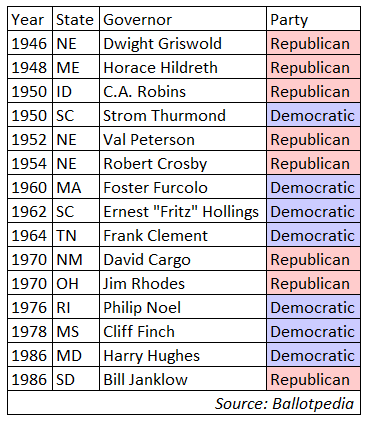
While a nearly 20% primary fail rate does not strike us as especially impressive for sitting governors, it has been nearly 4 decades since the last cases on Table 1. However, though it didn’t exactly fit our criteria, there is a more recent near-example. In Florida’s 2010 Senate contest, then-Gov. Charlie Crist (R), was initially a favorite for an open Senate seat that year. But with the rise of the Tea Party movement in GOP politics, current Secretary of State Marco Rubio emerged as the primary frontrunner and ran to Crist’s right. Crist instead ran for the Senate as an independent, and Rubio went on to win both the GOP nomination and the general election.
Something working in Mills’s favor may be that several of the governors listed on Table 1 did not have the institutional backing that we expect she’ll have. In 1978, the then-outgoing Sen. Jim Eastland (D), who had risen to become Mississippi’s dominant political figure over his 6 terms, made it known that then-Gov. Cliff Finch (D) was not his preferred successor. Other sitting governors on Table 1 opted to challenge senators in the primary. In 1986, a local-vs-national dynamic developed in South Dakota when then-Gov. Bill Janklow (R), who was popular with state Republicans, challenged first-term Sen. Jim Abdnor (R), who had support from several of his senatorial colleagues. Notably, the incumbent party went on to lose the seat in the general election in both of these instances.
Another race from Table 2 that seems worth noting is that in 1948, then-Gov. Horace Hildreth (R-ME) ran for the same seat that will be up in 2026. Hildreth, along with his immediate predecessor, Sumner Sewall, entered an open-seat GOP primary to replace Majority Leader Wallace White (R). In his biography of her, Frank Graham mentions that state power brokers tried to dissuade then-Rep. Margaret Chase Smith (R, ME-2) from running for Senate, even essentially offering her the governorship. Chase Smith, a liberal Republican who had backed key Roosevelt priorities and was outspent in the primary, overcame the more isolationist and establishment factions of her party. According to reporting at the time, she was running a shoestring campaign but benefitted as some of the pro-Hildreth camp’s heavy-handed antics backfired.
Beyond all of this, and beyond the history, the assessment that Maine Democrats are going to have to make is not only who they think would be a better senator, but also who is the stronger candidate against Collins. The conventional wisdom, and also the position of many national Democrats, is that someone like Mills is better-positioned, both because Mills has won before and because she is vetted in a way that Platner and others are not. This brewing Maine primary is an interesting test as to whether primary voters still buy into that conventional wisdom. The danger for Democratic voters if they repudiate the establishment is that they might end up picking a weaker candidate, as Republican primary voters have done on several occasions over the past 15 years. But there also might be risks in going with what the establishment wants, too, especially after the experience of the 2024 presidential election shook Democratic voters’ confidence in their leadership.
J. Miles Coleman is an elections analyst for Decision Desk HQ and a political cartographer. Follow him on Twitter @jmilescoleman.
Kyle Kondik is a Political Analyst at the Center for Politics at the University of Virginia and the Managing Editor of Sabato's Crystal Ball.
See Other Political Commentary by J. Miles Coleman.
See Other Political Commentary by Kyle Kondik.
See Other Political Commentary.
Views expressed in this column are those of the author, not those of Rasmussen Reports. Comments about this content should be directed to the author or syndicate.
Related Articles

Rasmussen Reports is a media company specializing in the collection, publication and distribution of public opinion information.
We conduct public opinion polls on a variety of topics to inform our audience on events in the news and other topics of interest. To ensure editorial control and independence, we pay for the polls ourselves and generate revenue through the sale of subscriptions, sponsorships, and advertising. Nightly polling on politics, business and lifestyle topics provides the content to update the Rasmussen Reports web site many times each day. If it's in the news, it's in our polls. Additionally, the data drives a daily update newsletter and various media outlets across the country.
Some information, including the Rasmussen Reports daily Presidential Tracking Poll and commentaries are available for free to the general public. Subscriptions are available for $4.95 a month or 34.95 a year that provide subscribers with exclusive access to more than 20 stories per week on upcoming elections, consumer confidence, and issues that affect us all. For those who are really into the numbers, Platinum Members can review demographic crosstabs and a full history of our data.
To learn more about our methodology, click here.
