The Senate: The Race for the Majority is Not a Toss-up, But the Races That Will Decide It Are
A Commentary By Kyle Kondik and J. Miles Coleman
KEY POINTS FROM THIS ARTICLE
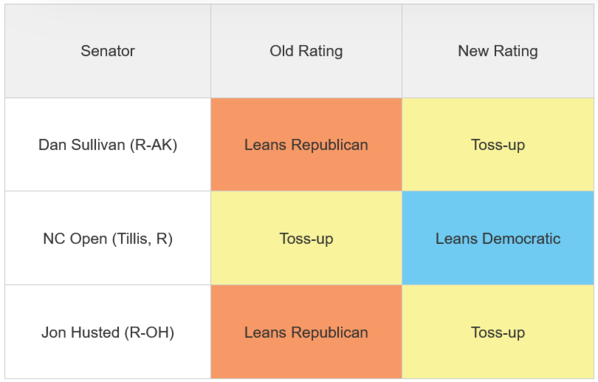
— We are making three Senate rating changes this week, all in favor of Democrats. North Carolina moves to Leans Democratic, and Alaska and Ohio are now Toss-ups.
— This makes the Democrats’ path to the majority clearer, but we still favor Republicans in the overall race for the Senate.
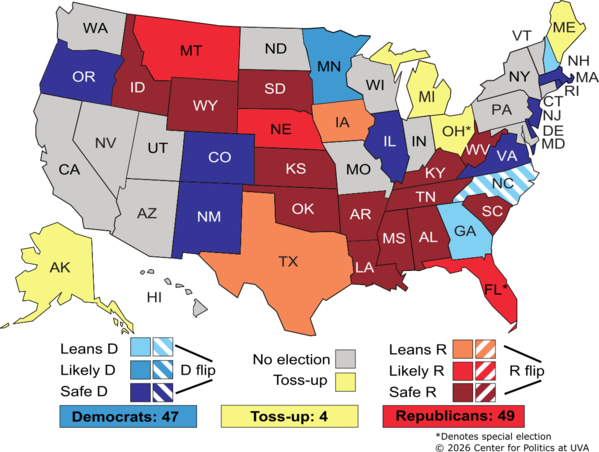
— Democrats need to win all four of our Toss-ups to get to a majority, while Republicans need just one to preserve a nominal 50-50 majority because they hold the vice presidential tiebreaker.
— Democrats also have their work cut out for them in the four Toss-ups, albeit for different reasons. In Maine and Michigan, there are questions about the quality of the Democratic candidates. In Alaska and Ohio, meanwhile, the questions are more about Democrats’ ability to overcome each state’s pronounced GOP lean.
Table 1: Crystal Ball Senate rating changes
Map 1: Crystal Ball Senate ratings
Updating the race for the Senate
As we reassess the Senate playing field with a little less than five months to go until the November election, three Senate ratings move in Democrats’ favor today, and there are now enough Toss-up races to give Democrats a clearer path to winning the Senate majority.
Our topline count now shows 49 seats Safe/Likely/Leans Republican (including races not being contested this year), 47 Safe/Likely/Leans Democratic, and 4 Toss-ups. If Democrats sweep the Toss-ups, they would win the Senate, assuming that the favored party wins the seats rated as Leans, Likely, and Safe. But Republicans can block Democrats by winning just one of the Toss-ups, meaning that they’re still better-positioned to hold the majority.
Today’s changes are more about the macro-level, big picture political factors as opposed to micro-level developments in these individual races. That includes polling, both in these races as well as the president’s poor approval rating combined with the House generic ballot, a catch-all assessment of the political environment. These big-picture factors haven’t really changed much in recent months although, to the extent they have, they’ve gotten worse for Republicans, to the point where 2026 could be as bad for Republicans as 2018 was, or perhaps even worse.
As these conditions have persisted, it’s become harder to give Republicans the benefit of the doubt in a state like North Carolina, which could become a true coin flip race by the time of the election but hasn’t seemed like one for months. Meanwhile, Alaska and Ohio increasingly seem like 50-50 races even though the states that are hosting those races are not 50-50 states.
At the same time, a race we continue to rate as a Toss-up—Maine, the only Kamala Harris-won state represented by a Republican, Susan Collins, in the Senate—now features an embattled Democratic nominee, veteran Graham Platner, an anti-establishment candidate who may wind up being Democrats’ answer to weak, outsider GOP nominees from the Tea Party era (and, more recently, the 2022 midterm) that cost Republicans winnable races. There are also questions about the quality of the eventual Democratic nominee in the open seat in Michigan, to the point where a race that probably could or should already be in the Democratic column does not yet seem to be.
Let’s go through the three races where we changed ratings, and then we’ll offer some updated thoughts on our other Toss-ups, Maine and Michigan.
North Carolina
In North Carolina, it increasingly appears that former Gov. Roy Cooper (D) has the upper hand. There probably was a case, given his history in the state, for starting him out as a favorite as soon as he entered the contest nearly a year ago. However, our thinking in holding the race as a Toss-up was that North Carolina—especially in Senate races—has proven elusive for Democrats. When this seat was last up in 2020, Democratic nominee Cal Cunningham led in most public polls and appeared well-positioned for much of the campaign, only to fall about a point and a half short on Election Day, hurt both by personal scandal and also Donald Trump’s presidential victory in the state. More broadly, Democrats have repeatedly come close in high-profile federal races in North Carolina without quite getting over the finish line.
Earlier this cycle, we noted that given Democrats’ history of falling short in closely contested North Carolina federal races, simply holding a narrow lead in the mid-40s would not necessarily be enough to flip the seat. In the past several polls however, Cooper has been around the 50% mark.
Meanwhile, we are somewhat underwhelmed with former Republican National Committee Chairman Michael Whatley’s efforts as the GOP nominee. With Trump’s standing in the state double-digits underwater in multiple polls, we wonder if Whatley has tied himself too closely to the president. For instance, last month, Whatley expressed support for Trump’s “anti-weaponization” fund even as the idea proved beyond the pale for several of his would-be Republican colleagues in the Senate. In fact, the three Republican incumbents we now list in Toss-up—Susan Collins of Maine, Jon Husted of Ohio, and Dan Sullivan of Alaska—joined with Democrats on an ultimately unsuccessful vote to block the fund.
Though Whatley currently polls around 40%, we expect the race to tighten as Election Day draws nearer. Whatley is simply less familiar to voters, so it’s easy to see conservatives “coming home” to some degree. And while Cooper, one of the strongest Democratic fundraisers on the Senate map, has handily outraised Whatley on a candidate-to-candidate basis, it is possible that conservative outside groups could help close the gap. As noted above, this may end up as a razor-thin race by Election Day. But it also doesn’t have to become that, and Cooper may just ride out the race and win by a clearer margin.
Alaska and Ohio
The Buckeye State and Last Frontier have long seemed like the most promising targets for Democrats among the list of potentially competitive double-digit Trump states that Republicans are defending in the Senate. We’re formalizing their status by moving them to Toss-up, even as it may ultimately be the case that the GOP lean of both states is too much for the challengers to overcome.
There are some similarities between both candidate matchups. Former Rep. Mary Peltola (D, AK-AL) and former Sen. Sherrod Brown (D-OH) both lost in 2024 but ran well ahead of Kamala Harris in their states, losing by about 2.5 and 3.5 points respectively. They each face incumbents, two-term Sen. Dan Sullivan (R-AK) and appointed Sen. Jon Husted (R-OH). Both are fairly run-of-the-mill Republicans, which is probably an improvement on the candidates Peltola and Brown lost to in 2024. Peltola was defeated by now-Rep. Nick Begich III (R, AK-AL), who was not the preferred candidate of national Republicans in the leadup to that election. Brown, meanwhile, lost to now-Sen. Bernie Moreno (R-OH), an inexperienced candidate who made some ill-advised comments during the campaign. Ohio is a big Midwest state that has moved to the right in the Trump era; Alaska is a far-flung, sparsely-populated state that has long been Republican, but whose Republican lean has lessened a bit in the Trump era. They voted similarly for president in 2024, with Trump winning Ohio by 11 points and Alaska by 13.
In Ohio, Fox News turned heads last week with a poll showing Brown up 53%-45% on Husted in the race for the final two years of Vice President JD Vance’s (R) unexpired term (meaning that this race will be on the ballot again in 2028). We doubt Brown is actually up by that much but he very well may be leading, even as scattered, earlier public polls more often than not showed Husted ahead. Despite Husted serving in state government for a quarter century, including as speaker of the state House, secretary of state, and lieutenant governor before Gov. Mike DeWine (R-OH) appointed him to the Senate, he does not seem particularly well-defined. Brown himself has been around much longer than Husted, and Republicans will argue that he’s yesterday’s man. Brown’s margin of defeat may have been lower than it otherwise could have been in 2024, as a Libertarian took about 3.5%, and there will be a Libertarian on the ballot again this fall. A Democrat getting to 50% may be a bridge too far in Ohio, but 48.5%-49% is more plausible.
Alaska, meanwhile, does not get polled very much, at least publicly. The only recent public polling is from Ivan Moore’s Alaska Survey Research (Moore has worked for Democrats). Peltola has been leading Sullivan in those polls after Sullivan led last summer, before Peltola was a candidate. Alaska has some political quirks, including coalition majorities in both state legislative chambers as well as a top-four election system in which all candidates run together in an August primary and then the top four finishers advance to a general election, where a ranked-choice vote decides the winner if no one finishes over 50% initially. Sullivan and Republicans were incensed recently as another Dan Sullivan filed to run as a Republican—Sen. Sullivan is accusing Democrats of a dirty trick, and Republicans are trying to get him off the ballot. The whole matter probably isn’t that important in the grand scheme of things, particularly with a ranked-choice voting system that may narrow the race down to Peltola vs. the “real” Sullivan in the final allocation.
We have debated whether both Ohio and Alaska belong as Toss-ups, and we keep coming back to this basic point: If both Peltola and Brown could come reasonably close in 2024 as Trump was carrying their states by double digits, doesn’t it seem plausible that both have a reasonable chance to win in what should be a much better political environment than 2024 was? Meanwhile, Sullivan and Husted would probably be fine in most years against most opponents, but this may not be most years, and Peltola and Brown are not most opponents.
Maine, Michigan, and more
— On Tuesday night, veteran Graham Platner (D) won a little more than 70% of the vote, easily winning the Democratic nomination for Senate in Maine despite mounting baggage. Platner survived and even thrived amidst a string of negative stories that began last fall, including both the revelation of a skull and crossbones tattoo that resembled a Nazi symbol as well as many controversial Reddit posts. Throughout it all, Platner captured the minds of Maine Democrats to such an extent that he crowded out Gov. Janet Mills (D-ME), a late entrant who never seemed all that enthusiastic about running. Mills dropped out well in advance of Tuesday’s primary as it became clear she would not beat Platner; her name remained on the ballot, and she got nearly 20% of the vote, which accounted for most of the “protest” vote against Platner. Ultimately, Platner is probably going to end up with about the same share of the vote as 2020 Maine Democratic Senate nominee Sara Gideon won in her own, lightly opposed primary.
More recently, new reporting emerged about Platner sending sexual text messages after being married as well as a New York Times report about “unsettling” behavior by Platner in past relationships. Beyond what’s already been reported, it seems likely that there will be more negative stories to come about Platner: If Republicans have found additional dirt on Platner that has not yet been reported, they may very well be holding onto it until mid-July, the deadline for Platner to drop out in time to be replaced by another Democrat. To Democrats who’d like to see Platner drop out, the recent reporting may be the “worst of both worlds”: the stories are arguably not bad enough to implore prominent Democrats to ask Platner to leave the race—indeed, few have—but they are potentially damaging enough to keep him on the defensive.
Collins may be more beatable than ever: Her own favorability is weak, and she’s only tied with Platner in her own recently released internal polling. Additionally, this being a midterm year as opposed to a presidential one also likely makes her job harder, as it is probably the case that the presidential race itself provided a release valve for those who disliked Trump to vote against him in 2020 but also split their tickets in favor of Collins. There’s no such release valve this year. But Platner’s problems may just be too much for the cross-pressured voters who have backed Collins in the past even as they vote Democratic in other races.
— In Michigan, Democrats are in the midst of a contested and sometimes agonizing three-way primary, which is still nearly two months away (Aug. 4). The eventual Democratic nominee will face the 2024 Republican Senate nominee, former Rep. Mike Rogers.
While the trajectory of the Democratic primary could change—particularly in a primary, eight weeks can be plenty of time—former Wayne County health director Abdul El-Sayed has led some (though not all) recent polls, and a couple of the most recent were ones sponsored by his campaign or supporters. In 2018, El-Sayed ran for governor with the support of Sen. Bernie Sanders (I-VT); though he lost that primary to now-outgoing Gov. Gretchen Whitmer (D), he has continued to position himself as the progressive choice. El-Sayed recently landed a notable endorsement from the United Auto Workers.
On the other end of the spectrum, Rep. Haley Stevens (D, MI-11), who is seen as the most “establishment” candidate, has claimed much institutional support; though neither of the state’s sitting Democratic senators have waded into the primary, former Sen. Debbie Stabenow (D-MI) is backing Stevens. Senate Minority Leader Chuck Schumer (D-NY) basically endorsed Stevens in an interview Wednesday with Punchbowl News.
But perhaps the key recent development in the primary was the decline of state Sen. Mallory McMorrow. McMorrow has a profile similar to that of Stevens—she is a white liberal woman hailing from one of Detroit’s better-off suburban communities—but she has tried to position herself as more of an outsider. For instance, she has said she would not back Schumer as Democratic Senate leader. Though McMorrow was in contention for first place earlier this year, she seems to have fallen into a solid third. This may be a case of a candidate who is struggling to find a “lane.”
For Democrats, the race has some echoes of Maine. Just as Republicans are excited to continue dumping opposition research on Platner, the Rogers campaign would likely welcome a matchup with El-Sayed, who is the Democrat that usually polls worst in the general election. According to averages from RacetotheWH, Stevens leads Rogers 45%-42%. McMorrow narrowly leads Rogers, while El-Sayed is narrowly behind him.
So this is all to say that we don’t really plan to reconsider our Toss-up rating in Michigan until at least after the early August primary. And before assuming that a purple-state Senate race will naturally just go to the non-presidential party in a midterm, we would advise readers to remember that Republicans flipped Florida as the presidential party in 2018 (back when Florida still seemed like a purple state) and Democrats did the same in Pennsylvania four years later.
— Georgia Republicans will decide between Rep. Mike Collins (R, GA-10) and former University of Tennessee football coach Derek Dooley (R) to be their Senate nominee in next week’s runoff. We will continue to favor Sen. Jon Ossoff (D-GA) over whomever wins the nomination.
— We wrote about the Iowa and Texas Senate elections in depth recently as we moved both from Likely Republican to Leans Republican—see those pieces for more on those races.
Kyle Kondik is a Political Analyst at the Center for Politics at the University of Virginia and the Managing Editor of Sabato's Crystal Ball.
J. Miles Coleman is the associate editor of Sabato’s Crystal Ball, the University of Virginia Center for Politics’ authoritative, nonpartisan newsletter on American campaigns and elections. He also serves as the Center’s Media Relations Coordinator. Follow him on Twitter @jmilescoleman.
See Other Political Commentary by Kyle Kondik.
See Other Political Commentary by J. Miles Coleman.
See Other Political Commentary.
Views expressed in this column are those of the author, not those of Rasmussen Reports. Comments about this content should be directed to the author or syndicate.
Related Articles

Rasmussen Reports is a media company specializing in the collection, publication and distribution of public opinion information.
We conduct public opinion polls on a variety of topics to inform our audience on events in the news and other topics of interest. To ensure editorial control and independence, we pay for the polls ourselves and generate revenue through the sale of subscriptions, sponsorships, and advertising. Nightly polling on politics, business and lifestyle topics provides the content to update the Rasmussen Reports web site many times each day. If it's in the news, it's in our polls. Additionally, the data drives a daily update newsletter and various media outlets across the country.
Some information, including the Rasmussen Reports daily Presidential Tracking Poll and commentaries are available for free to the general public. Subscriptions are available for $4.95 a month or 34.95 a year that provide subscribers with exclusive access to more than 20 stories per week on upcoming elections, consumer confidence, and issues that affect us all. For those who are really into the numbers, Platinum Members can review demographic crosstabs and a full history of our data.
To learn more about our methodology, click here.
