Notes on the State of Politics: MN-SEN to Likely Democratic; Watching Voter Dropoff in VA-AG Race
A Commentary By Kyle Kondik
KEY POINTS FROM THIS ARTICLE
— Republicans have a couple of open-seat Senate targets in Kamala Harris-won New Hampshire and Minnesota.
— History suggests Democrats should be able to hold both races, but Minnesota has clearly become a less attractive target for Republicans than New Hampshire.
— In Virginia’s closely-watched attorney general race, we are curious to see how many voters skip the AG contest entirely. Typically, the amount of dropoff from the gubernatorial race to the AG race is quite low.
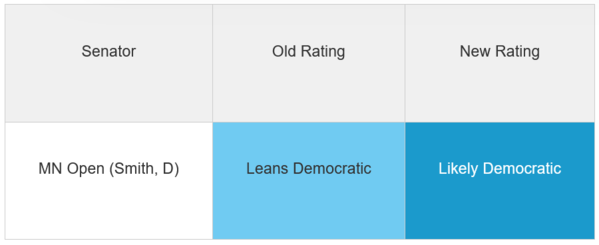
Table 1: Crystal Ball Senate rating change
Senate updates: Minnesota, New Hampshire, and Maine
Earlier this year, Democratic senators announced their retirements from a pair of states that have been typically Democratic at the federal level in recent years but are still competitive. In February, Sen. Tina Smith (D-MN) announced her retirement, and Sen. Jeanne Shaheen (D-NH) followed suit in March.
Minnesota and New Hampshire have both consistently voted Democratic for president since 2004—and Minnesota actually hasn’t voted Republican for president since backing Richard Nixon in his 1972 landslide—but these states were Kamala Harris’s smallest statewide victories in 2024. Harris carried the Granite State by 2.8 points last year, and she carried the Land of 10,000 Lakes by 4.2 points (her third and fourth-closest victories respectively, Virginia and New Jersey, host this year’s pair of gubernatorial contests—she won each of those states by a little under half a dozen points).
When the Minnesota and New Hampshire Senate races became open, we moved them from Likely Democratic to Leans Democratic as a nod to the increased uncertainty inherent in an open seat.
That said, neither race truly seems like a Toss-up in a midterm year like 2026. In such elections, it is hard for the presidential party (in this case, the Republicans) to play offense, particularly in states that did not support the president in the most recent presidential election.
One has to go back to 2002 to find a midterm example of the presidential party flipping a Senate seat in a state that the party did not win in the most recent presidential election. It actually came in one of these states: Minnesota. Liberal Sen. Paul Wellstone (D-MN) was locked in a close reelection race with then-former Saint Paul Mayor Norm Coleman (R) when Wellstone died in a plane crash less than two weeks before the election. Former Vice President Walter Mondale (D) stepped in to replace Wellstone, and Coleman won by 2 points. Obviously, the circumstances were unusual, and Wellstone may have won had he not died. But the overall point is that it took strange circumstances for a Republican to win a seat like this in the midst of a midterm with a Republican president in office (and George W. Bush was unusually popular in 2002 in the aftermath of 9/11 and in the leadup to the Iraq war, which Wellstone opposed).
It’s also fair to note that while Minnesota in 2002 was the last instance of the presidential party winning a midterm Senate race in a state that didn’t vote for the president, there have been a couple of more recent flipped seats that almost qualified for this list. In 2018, now-Sen. Rick Scott (R-FL) narrowly defeated then-Sen. Bill Nelson (D) in a state that Donald Trump had won by only a little more than a point in 2016, and in 2022, now-Sen. John Fetterman (D-PA) flipped an open seat in a state that Joe Biden carried by only a little more than a point in 2020.
This is all a way of saying that Republicans could flip Minnesota or New Hampshire next year, but either would be an upset. And, of those two, New Hampshire is the better Republican target—a distinction we’re formalizing by moving Minnesota from Leans Democratic to Likely Democratic while leaving New Hampshire as Leans Democratic.
On the Democratic side, New Hampshire appears essentially set while Minnesota hosts a competitive primary. Rep. Chris Pappas (D, NH-1), who has held down the more competitive of the state’s two congressional districts since the 2018 election, has established himself as the clear frontrunner for the nomination. Meanwhile, Minnesota Democrats will choose between, primarily, Rep. Angie Craig (D, MN-2) and Lt. Gov. Peggy Flanagan (D). Of the two, Craig is better-funded and more electorally proven—she, like Pappas, holds a competitive although Democratic-leaning district.
On the Republican side, though, there is a substantial difference between Minnesota and New Hampshire—they are doing better in recruitment for the latter while they are struggling in the former.
While Republicans struck out on trying to get popular former Gov. Chris Sununu to run for the New Hampshire Senate seat, his brother, former Sen. John E. Sununu (R), entered the race on Wednesday morning. John E. Sununu is set to face another former senator, Scott Brown, in the primary.
Meanwhile, Republicans could be again stuck with unsuccessful 2024 nominee Royce White in Minnesota: White, a former NBA player, has made a litany of controversial comments and does not seem capable of winning a statewide race. Adam Schwarze, a veteran, would be a more traditional nominee, and while he’s outraised White, he only raised about $260,000 in the recently-concluded third quarter, a modest sum for a Senate race (Craig raised nearly $2.2 million while Flanagan raised about $880,000 in the same timeframe). Sydney Kashiwagi of the Minnesota Star Tribune recently reported on the Republican field; the headline, “Republicans struggle to find candidate for open Minnesota U.S. Senate race,” says it all.
To be clear, Democrats remain favored in both of these open seats, and losing either would be catastrophic for their hopes of winning the Senate either in 2026 or beyond. But the chances of a Republican upset in Minnesota are lower than they are in New Hampshire, which is why Minnesota moves to Likely Democratic.
One other note on the Senate: last week, we devoted a couple of articles to the Maine Senate race, including a look at the Democratic primary between Gov. Janet Mills (D-ME) and oyster farmer Graham Platner (D) and what it might say about the future direction of the Democratic Party. Shortly after we published that story, CNN and other outlets began reporting on a series of offensive posts from Platner’s past. Then, earlier this week, Platner admitted to getting a skull and crossbones tattoo that has Nazi associations while he was serving in the military (Platner denies knowing about the association and got the tattoo covered up).
In our piece last week, we noted that Mills is better-vetted than Platner—but, wow, Platner sure is getting vetted now. It already would have seemed out of character for Democratic primary voters to take a leap of faith with Platner instead of Mills, and now Mills has a ton of opposition research to use against Platner if she needs it—and, considering the steady drip of these stories, there is likely more to come, as Jonathan Martin of Politico reported in a sharp column on Wednesday.
Virginia: Ticket-splitting, dropoffs, and write-ins
The focus in Virginia remains on the state attorney general race. While former Rep. Abigail Spanberger (D, VA-7) leads all recent polling against Lt. Gov. Winsome Earle-Sears (R) by varying margins in the gubernatorial race, Attorney General Jason Miyares (R) has more often than not led former state Del. Jay Jones (D) following the exposure of inflammatory text messages from Jones. Decision Desk HQ has polling averages for both races: Spanberger is up 50.4%-43.5% on Earle-Sears, while Miyares is up 47.1%-44.4% on Jones. Miyares is running about 3.5 points ahead of Earle-Sears’s vote share, while Jones is lagging a larger 6 points behind Spanberger’s vote share. The danger for Miyares is that the undecideds in the AG race may just be disproportionately Spanberger voters who, when push comes to shove, just end up voting a straight Democratic ticket. Needless to say, though, there is much more uncertainty about the AG race than the gubernatorial race.
This year, there are no named third-party candidates in any of the three statewide Virginia races. However, there is a write-in option, and it may also be that some voters skip the AG race altogether.
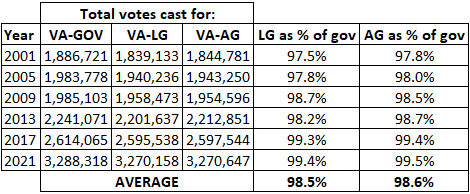
In recent Virginia elections, there have always been more votes cast for governor than there were for lieutenant governor and attorney general, and typically there is slightly less of an undervote for attorney general than there is for lieutenant governor. That makes some intuitive sense, as attorney general is a higher-profile and more powerful office than lieutenant governor. Table 2 shows the total number of votes cast for the three offices this century, as well as the percentage of total gubernatorial votes that were cast in the other two races.
Table 2: Total votes cast in Virginia statewide races, 2001-2021
Source: Calculated from Virginia Department of Elections data
As shown in Table 2, the down-ballot statewide races have averaged about 98.5% of the total votes for governor over this century, and the two most recent elections, 2017 and 2021, saw even less of an undervote. Because of Jones’s problems, one might anticipate that we’ll see a higher-than-average undervote for AG this year; regardless, Table 2 gives us a baseline for comparison.
The level of undervote in the other statewide races compared to governor in Virginia is actually smaller, on average, than the level of dropoff we saw in presidential-year Senate races from 2000-2024, which we wrote about after last year’s election. On average over the course of those seven presidential election cycles, Senate races across the country saw about 97.5% of the total votes cast for president, with Senate races almost always seeing fewer votes cast than state-level presidential contests. However, remember that we are comparing off-year Virginia gubernatorial elections to presidential election years—turnout is always going to be higher in a presidential year, and it stands to reason that the less-consistent voters who show up in a presidential year might be likelier to just vote for president and skip other races.
Then there are write-ins. Of the Virginia LG and AG races this century, only 1 of the 12 total contests had a named third-party candidate (the 2001 lieutenant governor race). In the 11 races that only had major-party candidates on the ballot, typically only about 0.1%-0.2% of the total votes went to write-ins. One race that saw slightly higher write-in voting was the 2013 lieutenant gubernatorial contest, which was the only race in 2013, 2017, or 2021 decided by double-digits (Democrat Ralph Northam won by a little over 10 points against an overmatched Republican opponent, E.W. Jackson). That race saw 0.4% of voters cast write-in ballots. We could also imagine a higher-than-usual share of write-ins in the AG race, although, again, one would not expect a lot of write-in votes.
Assuming Spanberger wins, and not just by a few points, Miyares’s path to victory consists of some combination of ticket-splitting as well as Spanberger voters skipping the AG race altogether or casting a protest write-in vote. We wanted to lay out the history in advance so we can see whether the actual undervote/write-in tally in the AG race ends up being high by recent Virginia standards or not.
Kyle Kondik is a Political Analyst at the Center for Politics at the University of Virginia and the Managing Editor of Sabato's Crystal Ball.
See Other Political Commentary by Kyle Kondik.
See Other Political Commentary.
Views expressed in this column are those of the author, not those of Rasmussen Reports. Comments about this content should be directed to the author or syndicate.
Related Articles

Rasmussen Reports is a media company specializing in the collection, publication and distribution of public opinion information.
We conduct public opinion polls on a variety of topics to inform our audience on events in the news and other topics of interest. To ensure editorial control and independence, we pay for the polls ourselves and generate revenue through the sale of subscriptions, sponsorships, and advertising. Nightly polling on politics, business and lifestyle topics provides the content to update the Rasmussen Reports web site many times each day. If it's in the news, it's in our polls. Additionally, the data drives a daily update newsletter and various media outlets across the country.
Some information, including the Rasmussen Reports daily Presidential Tracking Poll and commentaries are available for free to the general public. Subscriptions are available for $4.95 a month or 34.95 a year that provide subscribers with exclusive access to more than 20 stories per week on upcoming elections, consumer confidence, and issues that affect us all. For those who are really into the numbers, Platinum Members can review demographic crosstabs and a full history of our data.
To learn more about our methodology, click here.
