If it's in the News, it's in our Polls. Public opinion polling since 2003.

Search for "January 6"

Site search returned 233 matches

Sort results by

Last modified: 03/04/2014 08:36 AM Business

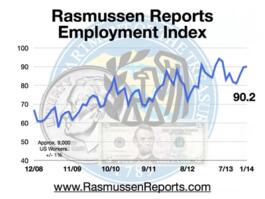
Rasmussen Employment Index Holds Steady in January

The Rasmussen Employment Index which measures worker confidence rose less than half a point in January, just barely continuing the upward trend it began in November.

At 90.2, worker confidence is still at its highest level since June but is down five points from the all-time high of 94.4 in May of last year. The index hit a low for 2013 of 81.2 in October. It stood at 87.1 in January 2013.

Generally speaking, an increase in the Rasmussen Employment Index suggests the upcoming government report on job creation will be stronger than the prior month’s report.

(Want a free daily e-mail update? If it's in the news, it's in our polls). Rasmussen Reports updates are also available on Twitter or Facebook.

The survey of 9,060 working Americans was conducted in January 2014 by Rasmussen Reports. The margin of sampling error is +/- 1 percentage points with a 95% level of confidence. Field work for all Rasmussen Reports surveys is conducted by Pulse Opinion Research, LLC. See methodology.

Last modified: 03/03/2014 08:28 AM Archive

Obama’s Full-Month Rating Up Another Point in January

When tracking President Obama’s job approval on a daily basis, people sometimes get so caught up in the day-to-day fluctuations that they miss the bigger picture.  To look at the longer-term trends, Rasmussen Reports compiles the numbers on a full-month basis, and the results can be seen in the graphics below.  

The president’s total job approval rose a point to 48% in January. That’s up from 45% in November, the president’s lowest monthly approval in two years, but still down eight points from December 2012’s recent high of 56%. The president's rating took a hard hit in November from the problems surrounding the rollout of the new national health care law but gained two points by the end of the year. Through much of November and early December, Obama’s daily job approval ratings were at the lowest levels of his entire presidency.

(Want a free daily e-mail update? If it's in the news, it's in our polls). Rasmussen Reports updates are also available on Twitter or Facebook

Last modified: 02/26/2014 01:31 PM Most Recent Videos

What America Thinks: Just 6% Think U.S. Has the Best Tax System in the World

April 15 will be here soon, and roughly half of Americans believe they pay more than their fair share in taxes.

Last modified: 01/01/2014 07:48 AM Lifestyle

6% Consider New Year’s Day One of the Most Important Holidays

Most Americans don't consider it a very important holiday, but many plan to keep the New Year’s Eve celebrations going right on through New Year’s Day.

A new Rasmussen Reports national telephone survey finds that just six percent (6%) of American Adults rate New Year’s Day one of the nation’s most important holidays, while 34% view it as one of the least important. Most (55%) see it as somewhere in between. (To see survey question wording, click here.)

(Want a free daily e-mail update? If it's in the news, it's in our polls). Rasmussen Reports updates are also available on Twitter or Facebook.

The survey of 1,000 American Adults was conducted on December 30, 2013 by Rasmussen Reports. The margin of sampling error is +/- 3 percentage points with a 95% level of confidence. Field work for all Rasmussen Reports surveys is conducted by Pulse Opinion Research, LLC. See methodology.

Last modified: 12/09/2013 10:42 AM Business

66% Think Long-Term Budget Deal to Avoid Another Shutdown Is Unlikely

Both sides insist a budget deal is near that will avoid another federal government shutdown, but most voters still want budget cuts and remain skeptical that such a deal is coming.

Just 12% of Likely U.S. Voters favor a federal budget that increases government spending, according to a new Rasmussen Reports national telephone survey. Fifty-six percent (56%) prefer a long-term budget deal that cuts spending instead. Twenty-five percent (25%) want to keep federal spending about the same. (To see survey question wording, click here.)

(Want a free daily e-mail update? If it's in the news, it's in our polls). Rasmussen Reports updates are also available on Twitter or Facebook.

The survey of 1,000 Likely Voters was conducted on December 6-7, 2013 by Rasmussen Reports. The margin of sampling error is +/- 3 percentage points with a 95% level of confidence. Field work for all Rasmussen Reports surveys is conducted by Pulse Opinion Research, LLC. See methodology.

Last modified: 10/23/2013 12:55 PM Business

64% Think Another Shutdown Likely in Mid-January

Most voters want a long-term budget deal that cuts federal spending but expect another government shutdown soon because Congress can’t reach such a deal.

Just 15% of Likely U.S. Voters favor a federal budget that increases spending, according to a new Rasmussen Reports national telephone survey. Fifty-four percent (54%) prefer a budget that cuts spending instead, while 25% want one that keeps spending levels about the same. (To see survey question wording, click here.)

(Want a free daily e-mail update? If it's in the news, it's in our polls). Rasmussen Reports updates are also available on Twitter or Facebook.

The survey of 1,000 Likely Voters was conducted on October 18-19, 2013 by Rasmussen Reports. The margin of sampling error is +/- 3 percentage points with a 95% level of confidence. Field work for all Rasmussen Reports surveys is conducted by Pulse Opinion Research, LLC. See methodology.

Last modified: 07/05/2013 08:16 AM Archive

6% Think Congress Doing Good or Excellent Job

Positive assessments of Congress’ job performance remain in single digits again this month, and they’re not thrilled with their own representative either.

Only six percent (6%) of Likely U.S. Voters give Congress good or excellent marks for the job it is doing, according to a new Rasmussen Reports national telephone survey. Sixty-four percent (64%) rate its performance as poor. (To see survey question wording, click here.) Those ratings are little changed from April.

Win an iPad: The Rasmussen Challenge is now live!

(Want a free daily e-mail update? If it's in the news, it's in our polls). Rasmussen Reports updates are also available on Twitter or Facebook.

The survey of 1,000 Likely Voters was conducted on June 2-3, 2013 by Rasmussen Reports. The margin of sampling error is +/- 3 percentage points with a 95% level of confidence. Field work for all Rasmussen Reports surveys is conducted by Pulse Opinion Research, LLC. See methodology.

Last modified: 05/24/2013 11:47 AM Politics

Favorable Views of Tea Party Up 14 Points Since January

Favorables for the Tea Party have jumped since news broke that the Internal Revenue Service was targeting the grassroots movement and other conservative groups. 

A new Rasmussen Reports national telephone survey shows that 44% of Likely U.S. Voters now have a favorable opinion of the Tea Party. That's up 14 points from January but still down from April 2009's high of 51% when the Tea Party protests against President Obama’s spending policies first erupted.

Forty-four percent (44%) also now view the Tea Party unfavorably, although that's down five points from earlier this year. The latest findings include 18% with a Very Favorable opinion of the movement and 25% with a Very Unfavorable one. Thirteen percent (13%) are undecided. (To see survey question wording, click here.)

The survey of 1,000 Likely Voters was conducted on May 21-22, 2013 by Rasmussen Reports. The margin of sampling error is +/- 3 percentage points with a 95% level of confidence. Field work for all Rasmussen Reports surveys is conducted by Pulse Opinion Research, LLC. See methodology.

Last modified: 03/08/2013 11:02 AM Politics

6% View Hugo Chavez Favorably

Very few voters have a favorable opinion of Venezuelan strongman Hugo Chavez who died earlier this week, but they’re also not very optimistic that U.S. relations with Venezuela will get any better.

The latest Rasmussen Reports national telephone survey finds that just six percent (6%) of Likely U.S. Voters share a favorable opinion of Chavez. Sixty-seven percent (67%) view the late Venezuelan leader unfavorably, while 27% are not sure. (To see survey question wording, click here.)

How did you do in this week’s Rasmussen Challenge? Check the leaderboard. 

The survey of 1,000 Likely Voters was conducted on March 6-7, 2013 by Rasmussen Reports. The margin of sampling error is +/- 3 percentage points with a 95% level of confidence. Field work for all Rasmussen Reports surveys is conducted by Pulse Opinion Research, LLC. See methodology.
White letter R on blue background
Last modified: 03/05/2013 07:38 AM Archive

Worker Confidence Slips in January

The Rasmussen Employment Index which measures worker confidence fell four points in January from a five-year high the month before, but the index remains above monthly levels measured for most of 2012.

At 87.1, the Employment Index is up six points from the start of 2012 and up 10 points from January 2011.

The survey of 9,476 working Americans was conducted in January 2013 by Rasmussen Reports. The margin of sampling error is +/- 1 percentage points with a 95% level of confidence. Field work for all Rasmussen Reports surveys is conducted by Pulse Opinion Research, LLC. See methodology.
Last modified: 02/28/2013 11:39 AM Politics

Only 6% Rate News Media As Very Trustworthy

Most voters still get their news from television and consider the news reported by the media generally trustworthy.

Fifty-six percent (56%) of Likely U.S. Voters say they get most of their news from TV, including 32% who get it from cable news networks and 24% who get it from traditional network news. A new Rasmussen Reports national telephone survey finds that another 25% use the Internet as their main source of news, while only 10% still rely on print newspapers. Seven percent (7%) get most of their news from radio. (To see survey question wording, click here.)

How did you do in the new Rasmussen Challenge? Check the leaderboard to find out. 

The survey of 1,000 Likely Voters was conducted on February 26-27, 2013 by Rasmussen Reports. The margin of sampling error is +/- 3 percentage points with a 95% level of confidence. Field work for all Rasmussen Reports surveys is conducted by Pulse Opinion Research, LLC. See methodology.
Last modified: 11/14/2012 11:10 AM Politics

51% Think Deal To Avoid ‘Fiscal Cliff’ Likely by January 1

President Obama will hold a press conference today to push his deficit-cutting plan as lawmakers in Washington battle over ways to prevent the massive tax hikes and spending cuts scheduled for January 1.  Given the partisan bickering, a bare majority of voters thinks a deal to avoid going over the so-called “fiscal cliff” is likely to emerge before then.

The latest Rasmussen Reports national telephone survey finds that 51% of Likely U.S. Voters now believe it is likely that Congress and the president will agree on a plan to stop the tax increases and spending cuts before the first of the year. Forty-two percent (42%) think a deal is unlikely to emerge. These findings include only 15% who feel a deal is Very Likely and just as many (14%) who say it’s Not At All Likely. (To see survey question wording, click here.)

Win an IPad: Take the Rasmussen Challenge

(Want a free daily e-mail update ? If it's in the news, it's in our polls). Rasmussen Reports updates are also available on Twitter or Facebook.

The survey of 1,000 Likely Voters was conducted on November 12-13, 2012 by Rasmussen Reports. The margin of sampling error is +/- 3 percentage points with a 95% level of confidence. Field work for all Rasmussen Reports surveys is conducted by Pulse Opinion Research, LLC. See methodology.

White letter R on blue background
Last modified: 05/30/2012 01:38 PM Archive

Rasmussen Employment Index Falls Back to January Level

The Rasmussen Employment Index slipped another three points in April, bringing the index down to the level measured at the start of 2012. At 80.7, the index is still above findings throughout 2011 and matches the level measured in January. In February, the index hit a three-year high of 87.7. April’s index is up six points from a year ago and seven points from two years ago.

The survey of 8,891 working Americans was conducted in April 2012 by Rasmussen Reports. The margin of sampling error is +/- 1 percentage points with a 95% level of confidence. Field work for all Rasmussen Reports surveys is conducted by Pulse Opinion Research, LLC . See methodology.

White letter R on blue background
Last modified: 05/04/2012 08:44 AM Archive

6% Rate Congress’ Job Performance As Good or Excellent

Positive ratings for Congress are back in the single digits where they have been for the past year.

A new Rasmussen Reports national telephone survey finds that six percent (6%) of Likely U.S. Voters now rate Congress’ performance as good or excellent.  Sixty-eight percent (68%) think Congress is doing a poor job.  (To see survey question wording, click here.)

(Want a free daily e-mail update? If it's in the news, it's in our polls). Rasmussen Reports updates are also available on Twitter or Facebook.

The survey of 1,000 Likely Voters was conducted on March 29-30, 2012 by Rasmussen Reports. The margin of sampling error is +/- 3 percentage points with a 95% level of confidence. Fieldwork for all Rasmussen Reports surveys is conducted by Pulse Opinion Research, LLC. See methodology.

Last modified: 04/13/2012 08:24 AM Politics

What They Told Us: Reviewing Last Week’s Key Polls - Week Ending April 6, 2012

The Easter weekend comes as a welcome pause for many after a week of high-profile political debate over the role of the U.S. Supreme Court and the release of employment numbers that remind us the economy’s still in shaky condition.

After reaching a three-year high in February, the Rasmussen Employment Index slipped four points in March. Generally speaking, a decrease in the index suggests the upcoming government reports on job creation will be weaker than the prior month’s, and that was again the case this month. The number of Americans who know someone who’s given up looking for a job out of frustration is up five points from a month ago to 48%.

The Rasmussen Consumer and Investor Indexes ended the week with slight increases, and both are running 10 or more points ahead of where they were in January. However, it remains to be seen how the jobs’ report affects confidence in the coming days.

Last modified: 03/09/2012 12:01 PM Politics

Mississippi Primary: Romney 35%, Santorum 27%, Gingrich 27%, Paul 6%

Rasmussen Reports’ first Republican primary survey in Mississippi shows former Massachusetts Governor Mitt Romney leading his closest competitors by eight points. A new statewide telephone survey of Likely GOP Primary Voters in the Magnolia State shows Romney with 35% of the vote, while former Pennsylvania Senator Rick Santorum and former House Speaker Newt Gingrich each draw support from 27%. Texas Congressman Ron Paul runs last with six percent (6%). One percent (1%) prefers some other candidate, and four percent (4%) are undecided. (To see survey question wording, click here.)

This Mississippi survey of 750 Likely Republican Primary Voters was conducted on March 8, 2012 by Rasmussen Reports. The margin of sampling error is +/- 4 percentage points with a 95% level of confidence. Field work for all Rasmussen Reports surveys is conducted by Pulse Opinion Research, LLC. See methodology.
White letter R on blue background
Last modified: 02/17/2012 08:25 AM Archive

Arizona GOP Primary: Romney 48%, Gingrich 24%, Santorum 13%, Paul 6%

Former Massachusetts Governor Mitt Romney has a big lead over his rivals in the first Rasmussen Reports survey of the Republican primary race in Arizona. The state's Republicans vote on February 28. A new telephone survey of Likely Republican Primary Voters in Arizona shows Romney with 48% support, while former House Speaker Newt Gingrich comes in a distant second with 24%. Thirteen percent (13%) prefer former Pennsylvania Senator Rick Santorum, and six percent (6%) support Texas Congressman Ron Paul. Two percent (2%) like some other candidate in the race, and six percent (6%) are undecided. (To see survey question wording, click here.)

(Want a free daily e-mail update? If it's in the news, it's in our polls). Rasmussen Reports updates are also available on Twitter or Facebook.

This Arizona survey of 750 Likely Republican Primary Voters was conducted on February 1, 2012 by Rasmussen Reports. The margin of sampling error is +/- 4 percentage points with a 95% level of confidence. Field work for all Rasmussen Reports surveys is conducted by Pulse Opinion Research, LLC. See methodology.

White letter R on blue background
Last modified: 02/03/2012 07:44 AM Politics

What They Told Us: Reviewing Last Week’s Key Polls - Week Ending January 28, 2012

President Obama on Tuesday night delivered his final State of the Union speech before Election Day, and the public seems receptive to at least two of his major economic initiatives. At the same time, the race between the men who want his job has seesawed, with the latest numbers from Florida’s upcoming primary suggesting Newt Gingrich’s surge may have crested.

Fifty-five percent (55%) of Likely U.S. Voters agree with the president’s proposal that wealthy Americans pay at least 30% of their income in federal taxes. But 49% also think federal, state and local governments combined shouldn’t take more than 30% of anyone’s income in taxes. These findings suggest that while voters feel generally that the wealthy aren’t paying their fair share, they remain more interested in fairness than in being punitive.

White letter R on blue background
Last modified: 01/27/2012 08:38 AM Politics

What They Told Us: Reviewing Last Week’s Key Polls - Week Ending January 20, 2012

And then there were four. The South Carolina Primary claimed two of the Republican presidential hopefuls this past week – Jon Huntsman and Rick Perry – before a single vote was cast. Mitt Romney and Newt Gingrich are now running nearly even, but with all the charges in the air, who knows if that will last until the votes are counted this evening?

Gingrich surged ahead of Romney 33% to 31% in the final Rasmussen Reports survey of the South Carolina Republican Primary race taken Wednesday evening. Two days earlier, before a strong debate showing by Gingrich and Sarah Palin’s endorsement of the former House speaker, it was Romney by 14 percentage points. 

Texas Congressman Ron Paul ran third on Wednesday with 15% of the vote, followed by former U.S. Senator Rick Santorum at 11%. Paul's support held steady while Santorum's support dropped five points since Monday.  At the beginning of the month, after Santorum’s strong showing in the Iowa caucuses, he ran second to Romney with 24%. Perry pulled two percent (2%) support Wednesday evening but has since dropped out of the race.

White letter R on blue background
Last modified: 01/20/2012 08:17 AM Politics

What They Told Us: Reviewing Last Week’s Key Polls - Week Ending January 14, 2012

Next Saturday’s South Carolina Republican Primary is expected to thin the pack of presidential hopefuls, but for now Mitt Romney, winner of both the Iowa caucuses and last Tuesday’s New Hampshire Primary, is the man to beat. New numbers out of South Carolina and Florida suggest that may be easier said than done.

Romney still holds first place in the South Carolina Primary field, while his opponents jockey for second. The former Massachusetts governor earns 28% support, virtually unchanged from a week ago, but now former House Speaker Newt Gingrich is in second place with 21% of the vote.  Support for former U.S. Senator Rick Santorum who was in second a week ago has fallen back to 16%, putting him dead even with Texas Congressman Ron Paul who also earns 16%.

Texas Governor Rick Perry, whose continued candidacy likely depends on the South Carolina vote, now captures six percent (6%) support, while former Utah Governor Jon Huntsman runs last with five percent (5%).

Of course, much can change in the closing days before the South Carolina primary, with just 52% who say they are certain of their vote at this time. In Iowa, a late surge by Santorum nearly swept him to victory. In New Hampshire, Paul and Huntsman made gains in the final days of the campaign. This suggests whoever is perceived as the most effective tactical alternative to Romney could see a last-minute surge in South Carolina as well.