Scott Rasmussen on Fox News - October 15, 2011
Scott Rasmussen discusses the latest national 2012 Republican Primary poll.

Scott Rasmussen discusses the latest national 2012 Republican Primary poll.
Franklin Delano Roosevelt once said that "There is nothing I love as much as a good fight." If so, he would've hated where the House is headed for the next decade, because by and large it likely won't have all that many good fights.

Most voters don’t like the Federal Reserve, the nation’s central banking system, which at least one presidential candidate would like to abolish.

Although the nation is facing hard economic times, most Americans still regard their own life positively.
A new Rasmussen Reports national telephone survey finds that 59% of American Adults rate their own lives today as good or excellent, including 22% who say their life is excellent. Just nine percent (9%) rate their lives today as poor. (To see survey question wording, click here).
Following a fiery debate Tuesday night, Texas Governor Rick Perry now trails President Obama by eight points in the latest 2012 hypothetical matchup.
Reflecting national trends, businessman Herman Cain has now jumped to the front of the Republican pack in Iowa.
A new Rasmussen Reports telephone survey of Likely Iowa caucus-goers shows that Cain is in front with 28% followed by former Massachusetts Governor Mitt Romney at 21%. Congressman Ron Paul is a distant third at 10% followed by former House Speaker Newt Gingrich at 9%, Congresswoman Michelle Bachmann at 8%, and Texas Governor Rick Perry at 7%. The sixth place finish for Perry is a sharp decline from early September when Perry was the frontrunner both nationally and in Iowa. (To see survey question wording, click here).
Former Senator Rick Santorum picks up 4% of the vote and former Governor Jon Huntsman is at 2%. Another 4% would prefer some other candidate and 8% are not sure.
Only one-third of the caucus-goers (32%) are certain of their vote and don’t expect to change their mind. Among these voters, 30% prefer Cain, 22% Romney, and 17% Paul.
Among those absolutely certain they will show up and participate in the caucus, Cain leads Romney 31% to 18%. Many have criticized the Cain campaign for not having a strong organization in Iowa which is seen as essential to turning out the vote. According to such conventional analysis, Cain might be at risk of raising expectations too high and then underperforming.
(Want a free daily e-mail update? If it's in the news, it's in our polls). Rasmussen Reports updates are also available on Twitter or Facebook.
The survey of 800 Likely Iowa Republican Caucus Participants was conducted on October 19, 2011 by Rasmussen Reports. The margin of sampling error is +/- 4 percentage points with a 95% level of confidence. Field work for all Rasmussen Reports surveys is conducted by Pulse Opinion Research, LLC. See methodology.
Reflecting national trends, businessman Herman Cain has now jumped to the front of the Republican pack in Iowa.
A new Rasmussen Reports telephone survey of Likely Iowa caucus-goers shows that Cain is in front with 28% followed by former Massachusetts Governor Mitt Romney at 21%. Congressman Ron Paul is a distant third at 10% followed by former House Speaker Newt Gingrich at 9%, Congresswoman Michelle Bachmann at 8%, and Texas Governor Rick Perry at 7%. The sixth place finish for Perry is a sharp decline from early September when Perry was the frontrunner both nationally and in Iowa. (To see survey question wording, click here).
Former Senator Rick Santorum picks up 4% of the vote and former Governor Jon Huntsman is at 2%. Another 4% would prefer some other candidate and 8% are not sure.
Only one-third of the caucus-goers (32%) are certain of their vote and don’t expect to change their mind. Among these voters, 30% prefer Cain, 22% Romney, and 17% Paul.
Among those absolutely certain they will show up and participate in the caucus, Cain leads Romney 31% to 18%. Many have criticized the Cain campaign for not having a strong organization in Iowa which is seen as essential to turning out the vote. According to such conventional analysis, Cain might be at risk of raising expectations too high and then underperforming.
(Want a free daily e-mail update? If it's in the news, it's in our polls). Rasmussen Reports updates are also available on Twitter or Facebook.
The survey of 800 Likely Iowa Republican Caucus Participants was conducted on October 19, 2011 by Rasmussen Reports. The margin of sampling error is +/- 4 percentage points with a 95% level of confidence. Field work for all Rasmussen Reports surveys is conducted by Pulse Opinion Research, LLC. See methodology.
We've been hearing a lot about immigration on the campaign trail, most of it based on outdated assumptions and echoing the arguments made when Congress was considering so-called comprehensive immigration reform bills in 2006 and 2007.
When trying to make sense of terrorists, we examine their "causes." In the cases of Muslim terrorists, we search their religious views and political indoctrination. But when looking at other Americans who commit outrages not overtly tied to some creed, we tend to focus on their inner turmoil rather than their big-picture resentments.

Though the government reported a modest climb in housing starts in September, the number of adults nationwide who say now is not the time to sell a home has reached an all-time high.
Fifteen percent (15%) of Likely U.S. Voters now say the country is heading in the right direction, according to a new Rasmussen Reports national telephone survey taken the week ending Sunday, October 16. That’s the lowest level measured in nearly two months of weekly tracking.
Canada and Great Britain are still viewed by most as America’s top allies, and more Americans view Germany and Japan that way.
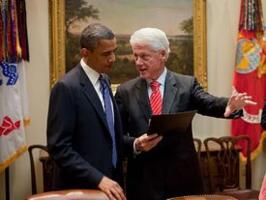
Describing a political candidate as being “like Bill Clinton” isn’t up there in popularity with a comparison to Ronald Reagan, but it’s much better than being called “a centrist,” a phrase often used for politicians willing to compromise.
Thirty-eight percent (38%) of Likely U.S. Voters consider it a positive label if a candidate is compared to Clinton, the 42nd president of the United States from 1993 to 2001. A new Rasmussen Reports national telephone survey finds that 24% consider such a comparison a negative, and 35% rate it somewhere in between the two.
While investors wait to see if the Europeans will agree to a major boost in their rescue fund to backstop sovereign debt and the banks who own it, here at home the economic news has turned slightly more positive.
For the past few years, fear of China's predatory mercantilism has been steadily growing in America, both amongst the public and in elite business and political circles. But last week, for the first time, one could discern the genuine possibility that America might actually do something about it -- even if it means a trade war.

One-out-of three U.S. homeowners continue to say their home is worth less than what they owe on it.
A generic Republican now leads President Obama by four points in a hypothetical 2012 match-up for the week ending Sunday, October 16.
A generic Republican now leads President Obama by four points in a hypothetical 2012 match-up for the week ending Sunday, October 16.

For most Americans, the best years of their lives happen before they turn 40.
Former Massachusetts Governor Mitt Romney and President Obama continue to run virtually even in a hypothetical Election 2012 matchup as they have for the past several weeks. Herman Cain is now the only Republican who has any kind of lead over the president.
