« If it's in the news it's in our polls. «
« Rasmussen produces some of the most accurate and reliable polls in the country today. »
-Larry Sabato, University of Virginia« Rasmussen, an organization with fast zeitgeist reflexes.... «
-The Politico« If it's in the news it's in our polls. «
« The best place to look for polls that are spot on is RasmussenReports.com «
-Michael Barone, The Washington Examiner`« If you really want to know what people in America think, you can't find a better place to look than Rasmussen Reports «
-Susan Estrich« If you have a choice between Rasmussen and, say, the prestigious N.Y.Times, go with Rasmussen! »
-Mickey Kaus, Slate Magazine
Advertisement
|
Advertisement
Partisan Politics
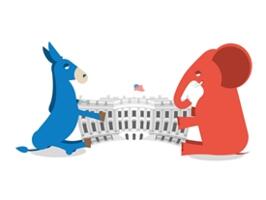
60% Say Somewhat Likely That Next President From GOP
Wednesday, January 06, 2010
Advertisement
Sixty percent (60%) of U.S. voters say it’s at least somewhat likely that the next president will be a Republican, A new Rasmussen Reports national telephone survey shows that 27% suggest that outcome is unlikely. Those figures include just 31% who say it’s very likely that a Republican will occupy the White House after Obama leaves and 29% who see it as a possibility. Still, the results are the most optimistic about the GOP presidential prospects since Rasmussen Reports began polling on the question just after President Obama took office. At that time, just 44% said it was even somewhat likely a Republican would occupy the White House next. It’s important to note that the question did not specify whether that next president will be elected in 2012 or 2016. (Want a free daily e-mail update? If it's in the news, it's in our polls). Rasmussen Reports updates are also available on Twitter or Facebook. Predictably, 81% of GOP voters say it’s likely that the next president will come from their party, and 60% of voters not affiliated with either major party agree. Interestingly, Democrats are almost evenly divided on the question. Voters continue to expect a high level of partisanship in Washington. Sixty-one percent (61%) say politics in Washington, D.C. will be more partisan over the next year Just 20% anticipate more cooperation, with 18% not sure. Those figures are little changed from a month ago. Voters were evenly divided just after Obama’s inauguration – 40% expected more partisanship, 40% more cooperation. Since then, those expecting more partisanship has ranged from a low of 49% in March to a high of 67% in August when the health care debate began heating up. Similarly, just 30% say the president is governing in a bipartisan fashion, roughly where that number has been since last May. Fifty-one percent (51%) say the president is governing like a partisan Democrat, and 19% are not sure. As for congressional Republicans, 23% say they’re acting in a bipartisan fashion, while 57% say they’re governing like partisan Republicans. These numbers, too, have changed little over the past year. Twenty percent (20%) aren’t sure. The same goes for congressional Democrats. Nineteen percent (19%) of voters say they’re governing in a bipartisan fashion, but 64% say they’re acting like partisan Democrats. Seventeen percent (17%) are undecided. These findings are similar to those found throughout the past year. Voters feel more strongly than ever that Congress is performing poorly and that most of its members are in it for themselves. Only 32% of voters are even somewhat confident that their representatives in Congress are actually representing their best interests. Sixty-seven percent (67%) are not confident that their congressional representatives are guided by what’s best for their constituents. In December, the number of Americans identifying themselves as Democrats fell to the lowest level recorded in more than seven years of monthly tracking by Rasmussen Reports. The number of Republicans inched up by a point in December to 34.0%. That’s the highest total for Republicans since December 2007, just before the 2008 presidential campaign season began. When Obama was inaugurated last January, Democrats had a seven-point lead on the Generic Congressional Ballot. Republicans now have a five-point advantage. That change has been brought about partly by the declining number of Democrats and partly by the fact that unaffiliated voters are now more supportive of the GOP. A plurality (49%) of voters says it is at least somewhat likely that Republicans will win control of Congress next year. Fifty-two percent (52%) say Republicans are the party most likely to gain seats in Congress in this year’s mid-term elections. In a month-by-month review of the Presidential Approval Index, Obama’s overall job approval ratings fell three points in December following two-point declines in both October and November. Looking back, the president’s honeymoon ended quickly before his ratings stabilized from March through May. They tumbled in June and July as the health care debate began before stabilizing again over the summer. Please sign up for the Rasmussen Reports daily e-mail update (it’s free) or follow us on Twitter or Facebook. Let us keep you up to date with the latest public opinion news.
See survey questions and toplines. Crosstabs and are available to Premium Members only. Rasmussen Reports is an electronic publishing firm specializing in the collection, publication, and distribution of public opinion polling information. The Rasmussen Reports Election Edge™ Premium Service offers the most comprehensive public opinion coverage available anywhere. Scott Rasmussen, president of Rasmussen Reports, has been an independent pollster for more than a decade. TOP STORIES75% Are Angry At Government’s Current Policies Americans Reject Keynesian Economics What They Told Us: Reviewing Last Week’s Key Polls Republicans Still Trusted More on Most Key Issues 45% Agree With CBS’ Decision To Run Tebow Ad, 30% Disagree 83% Blame Deficit on Politicians’ Unwillingness To Cut Spending Holder's Premature Mirandization of Suspect By Debra J. Saunders Politically Speaking, Populist Isn’t Popular, But Conservative Is Obama’s Budget: Fiscal Armageddon By Howard Rich Advertisement
|