McCain vs. Trump? GOP Voters Choose …
Do Republican voters have a slightly more favorable opinion of Donald Trump these days than they do of Senator John McCain?
Do Republican voters have a slightly more favorable opinion of Donald Trump these days than they do of Senator John McCain?

When it comes to campaign contributions, most voters think disclosure is more important than restrictions. Most also still believe substance matters more than money when it comes to election outcomes.

Voters overwhelmingly object to efforts to get rid of the U.S. flag and other symbols of the nation’s past that offend some Americans, but they're more hesitant about comparing those proposals to the historical cleansing being done by the radical Islamic group ISIS in the Middle East.
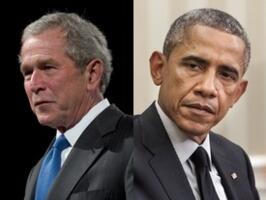
More than six years into Barack Obama's presidency, voters still tend to blame George W. Bush more than the current occupant of the White House for the state the U.S. economy is in.

President Obama recently hosted the head of Vietnam’s Communist Party at the White House in an effort to further strengthen America's relationship with its former foe, but how do voters here feel about that?
Following what appears to be the largest cyberattack against the U.S. government in history, voters seriously doubt the government can protect their private information and question its performance at protecting secrets.

No wonder few voters believe anymore that the federal government has the consent of the governed.
Most voters have been telling us for years that they favor spending cuts in every program of the federal government, but they remain skeptical that those cuts are ever going to come. A new Rasmussen Reports national telephone survey finds that just 28% of Likely U.S. Voters believe it is is even somewhat likely that government spending will be significantly reduced over the next few years. Sixty-five percent (65%) consider that unlikely.
Greece appears to have won a temporary stay in its economic troubles with yet another bailout plan from Europe. What do American voters think?
It’s shaping up to be yet another drawn-out battle in Congress over spending this summer, with Senate Democrats blocking a major defense spending bill late last month. Democrats oppose raising the level of defense spending without comparable increases in entitlement programs.

Puerto Rico is $72 billion in debt and can't pay its bills, but voters oppose a federal government bailout for the longtime U.S. commonwealth.

Following last week’s controversial U.S. Supreme Court rulings on Obamacare and gay marriage, voters believe more strongly that individual states should have the right to turn their backs on the federal courts.

Negative views of the U.S. Supreme Court are at their highest level in nearly nine years of regular surveying. But positive opinions are also up to a less dramatic three-year high.
A closer look at public attitudes about the recent rulings by the U.S. Supreme Court suggest that it’s largely an age thing. Especially when it comes to gay marriage.

The hits just keep on coming. The rogue Internet site WikiLeaks last week released its latest batch of illegally obtained classified U.S. documents, this time showing that America has spied on the last three French presidents. The French government has formally protested, as did the Germans when our spying on Chancellor Angela Merkel was similarly disclosed in 2013.

With the Department of Housing and Urban Development ready to release new regulations meant to diversify wealthy neighborhoods, American voters overwhelmingly say that it is not the government’s job to try to bring those of different income levels to live together.
Most voters don’t think the Confederate flag should be flown at the South Carolina Capitol, but they differ when it comes to the flag’s meaning.

Most voters agree that racial identity should be based on birth, not preference, but black voters are less critical than others of Rachel Dolezal, a white woman who identifies as black who recently resigned from her post at the NAACP.

Nearly 20 years ago, Bill Clinton declared the era of big government over. Two decades later, voters wish that were true.

Voters see an overly powerful government as a bigger danger in the world than an under-powered one.
Voters may question just how faithful President Obama has been to the U.S. Constitution, but they continue to stand firm in their own belief about the document that has been the supreme law of the United States for 227 years. (To see survey question wording, click here.)
