Most Want Schools to Open After Labor Day
More and more schools around the country are starting classes before Labor Day, but most Americans think they should hold off a bit.

More and more schools around the country are starting classes before Labor Day, but most Americans think they should hold off a bit.

While there’s disagreement over how to help students pay for it, Americans still overwhelmingly believe in the importance of a college degree to gaining employment.

While Americans are facing a record level of college-related debt, support remains low for forgiving student loans or taking the further step of having the government pay for students who can't afford to go to college.

Earlier this month the president of DePaul University announced that he is stepping down following student protests that culminated in the shutting down of a speech by a prominent young conservative writer. The growing number of similar protests at other colleges and universities in recent months has a sizable number of Americans questioning whether free speech has a place on modern campuses.

Philadelphia is the latest major school system to add Muslim holidays to its official calendar, but Americans with school-age children still aren’t sure that’s such a good idea, although support's up from a year ago.

Voters continue to have little faith in U.S. public schools and think it's mainly up to parents and the students themselves to succeed.

It’s about time for the latest crop of college graduates to enter the workforce, but Americans still aren’t confident about the job colleges are doing preparing those young minds.
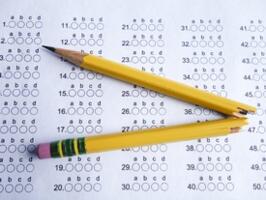
Parental opposition to standardized testing in schools remains high, even as the latest cycle of tests is beginning in many states. Most parents now say there’s no need for any such tests at all.

Detroit public school teachers are taking "sick-outs" in huge numbers in part to protest their pay, causing school shutdowns throughout the city and illustrating the power of public employee unions. Most Americans still agree that teachers are underpaid and have a slightly more positive view of teachers' unions these days.
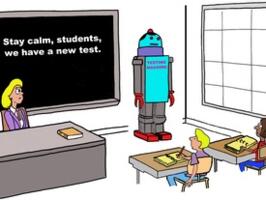
Congress and the president earlier this month scrapped the national education dictates of George W. Bush’s No Child Left Behind law and returned control of school standards to states and localities. This is expected to lessen the focus on standardized testing. Americans, especially those with school-age children, approve.
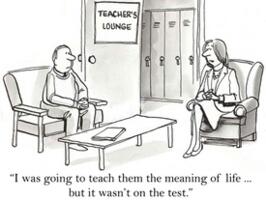
The Scholastic Aptitude Test (SAT) is set to be revamped soon following reports that scores across the country have fallen to troubling lows. But do poor SAT scores really mean poor students?

Should school take up more of a student's day?

School is in session in many places around the country, but Americans still tend to think it’s starting too early.

Americans are slightly less negative about the job prospects for the latest batch of college graduates but still aren’t very confident these graduates have much to offer prospective employers.

More Americans think it's a good idea for everyone to get additional schooling after high school, even though they're less convinced than they were several years ago that a college degree is worth what you pay for it.
Several prominent Democrats are championing the idea of debt-free college, and a lot of Americans agree the government should pay for those who can’t afford to go.

Nearly half of Americans dislike teachers' unions, but they're less upset that teachers belong to them. (To see survey question wording, click here.)
(Want a free daily e-mail update? If it's in the news, it's in our polls). Rasmussen Reports updates are also available on Twitter or Facebook.
The national survey of 800 Adults was conducted on April 8-9, 2015 by Rasmussen Reports. The margin of sampling error is +/- 3.5 percentage points with a 95% level of confidence. Field work for all Rasmussen Reports surveys is conducted by Pulse Opinion Research, LLC. See methodology.

Americans still have a very high opinion of teaching, but more than ever say it's not a job most people consider pursuing.
A new Rasmussen Reports national telephone survey finds that 67% of American Adults view being a teacher as one of the most important jobs in our country today. That's down from a high of 76% in 2012 but more in line with regular surveying since 2008. Twenty-three percent (23%) don't consider teaching that important, while 10% are undecided. (To see survey question wording, click here.)
(Want a free daily e-mail update? If it's in the news, it's in our polls). Rasmussen Reports updates are also available on Twitter or Facebook.
The national survey of 800 Adults was conducted on April 8-9, 2015 by Rasmussen Reports. The margin of sampling error is +/- 3.5 percentage points with a 95% level of confidence. Field work for all Rasmussen Reports surveys is conducted by Pulse Opinion Research, LLC. See methodology.
Additional information from this survey and a full demographic breakdown are available to Platinum Members only.

While most parents of elementary and secondary school children agree with celebrating some religious holidays in the schools, they don't include the two Muslim holidays that Mayor Bill de Blasio recently added to the New York City public school calendar. Christmas and Easter far and away top the list of religious holidays parents think schools should recognize. (To see survey question wording, click here.)
(Want a free daily e-mail update? If it's in the news, it's in our polls). Rasmussen Reports updates are also available on Twitter or Facebook.
The survey of 800 Adults was conducted on March 11-12, 2015 by Rasmussen Reports. The margin of sampling error is +/- 3.5 percentage points with a 95% level of confidence. Field work for all Rasmussen Reports surveys is conducted by Pulse Opinion Research, LLC. See methodology.

A lack of discipline in the public schools remains a major problem, but Americans tend to see inadequate funding as the biggest concern. (To see survey question wording, click here.)
(Want a free daily e-mail update? If it's in the news, it's in our polls). Rasmussen Reports updates are also available on Twitter or Facebook.
The survey of 800 American Adults was conducted on February 21-22, 2015 by Rasmussen Reports. The margin of sampling error is +/- 3 percentage points with a 95% level of confidence. Field work for all Rasmussen Reports surveys is conducted by Pulse Opinion Research, LLC. See methodology.
